The role of the environment in our children's development is much greater than we might think. Especially the home environment plays a vital role in the child's gaining self-confidence, being able to act independently, and becoming an individual open to learning. At this point, the Montessori approach offers a great source of inspiration for children's room decoration.
Montessori is an educational philosophy developed by Italian doctor and educator Maria Montessori, which respects the child's individual development process, pace, and freedom. This approach can be effectively applied not only in school environments but also at home and especially in children's rooms.
So, how should a children's room be according to Montessori principles? Which furniture should be chosen? What should be avoided? Let's explore together.
Montessori Room - Environment Prepared for Children
At the core of the Montessori philosophy lies the acceptance of the child as an individual and providing an environment in which they can become independent. According to this philosophy, one of the most influential factors in a child's development is the physical environment they interact with every day. Therefore, a children's room should not just be a sleeping area but a liberating living space where the child gains independence, learns to make choices, and makes discoveries at their own pace.
In the Montessori approach, the term "prepared environment" is frequently used. This refers to a space designed according to the child's age, physical size, interests, and level of development. Every item should be within the child's reach, and a simple and orderly environment should be created, free from clutter. Every item in the room should have a place; through this order, the child gradually develops a sense of responsibility and internal discipline.
A room decorated with this understanding gives the child the message "this space belongs to you and you can manage it." This not only boosts self-confidence but also supports independent decision-making skills at an early age.
Bed Choice: Close to the Ground and Safe
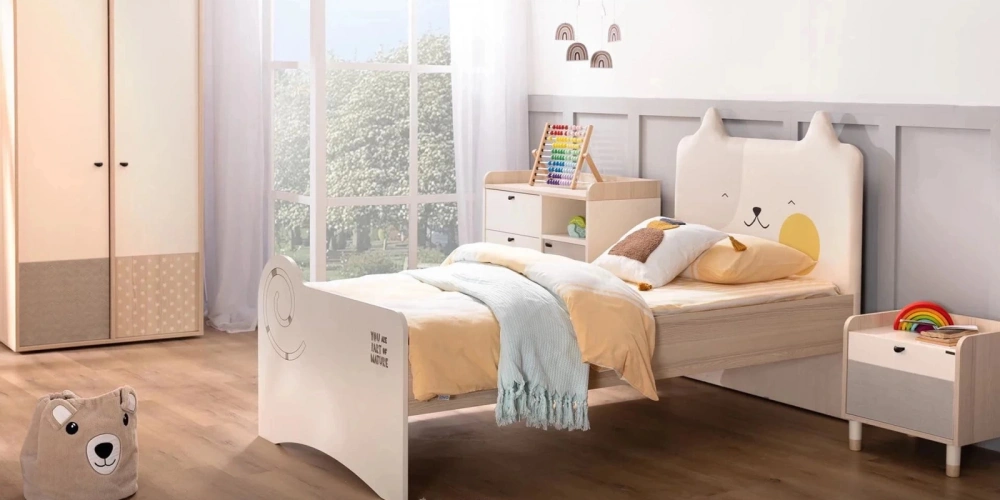
One of the most characteristic elements of Montessori rooms is beds close to the ground. Instead of traditional cribs or high beds, beds that children can get in and out of on their own, often frameless or with low frames, are preferred. This approach is developed to provide physical independence and ensure the child's safety.
With beds close to the ground, the child can get in and out of bed at will; this allows them to manage their sleep and waking rhythm independently. So the child benefits from the bed in their room not only for sleeping but also for discovering their freedom. After waking up, they can easily reach the books, toys, or clothes around them. Even this simple detail greatly contributes to the child's development of autonomy.
In addition, the risk of falling is reduced to a minimum compared to high beds. This provides a safer and more comforting environment, both physically and psychologically, especially for children who have just started walking.
From a decorative perspective, Montessori beds offer quite interesting options. Models produced with natural wood materials, simple but aesthetic designs harmonize with the general atmosphere of the room while creating a warm and peaceful environment. Some models feature tent forms, small roof appearances, or simple shelf details, supporting the child's imagination.
Scale and Simplicity Are Important in Furniture Selection
All furniture used in Montessori rooms should be suitable for the child's height. For example, a bookshelf should be designed low enough for the child to easily access; toy boxes should be open-shelved, and closet doors should be easy to open.
Furniture should be designed simply, naturally, and free from exaggeration. Colors that are not tiring to the eyes, natural wood tones, and pastel details are very suitable for this room style. Excessive ornamentation or complex designs can distract the child.
Toy and Book Arrangement: The Right to Choose Belongs to the Child
In the Montessori approach, the principle of "few but qualified" toys is adopted. This means limiting the number of toys but ensuring each one is educational, creative, or exploratory.
Toys should be placed in open shelves, organized by categories, and arranged in a way that the child can easily take and replace them. The same rule applies to books. By using front-facing bookshelves, the child can make decisions by seeing which book to choose, which develops a sense of independence.
Mirror, Hanger, and Personal Space
The use of mirrors in Montessori rooms is quite common. Especially for babies and small children, mirrors placed at eye level help them recognize themselves and develop their body awareness. Mirrors can be selected from acrylic or plexiglass materials for safety.
Additionally, low hooks or simple dressing areas should also be present in the room, allowing children to select and hang their clothes. This is very effective in acquiring daily life skills.
Security is the Top Priority in a Montessori Room
While the Montessori philosophy grants freedom to the child, this freedom should be provided within a safe framework. Sharp corners should be avoided, furniture should be fixed to the wall, and outlets should be made safe. Small-piece decorative products should be avoided, and toys should be chosen with age appropriateness in mind.
At this point, furniture and accessories specially produced for Montessori design provide great convenience in terms of both safety and simplicity.
Decorative Yet Functional Touches for Montessori Rooms
In Montessori rooms, decoration should not only carry visual appeal but also functionality. The child's drawings can be hung on the walls, and daily routine charts can be placed on wooden boards.
Additionally, a small table and chair set can be placed in the room; this area can be customized for activities such as reading, drawing, and solving puzzles. Remember, the owner of this room is the child, and every detail should be shaped according to their world.
A children's room decorated with the Montessori approach not only creates a stylish and orderly space but also supports the growth of your child as a confident, responsible, and independent individual.























 Contact us
 +90 850 800 34 87