Choosing and decorating a
children's room set isn't just about aesthetics; it also requires attention to safety, functionality, and developmental needs. A room designed well supports the child's physical and mental development, making them feel safe and free. The main goal of decoration is creating an environment where basic needs such as play, sleep, and learning are balanced.
In this article, we will discuss the most important details to consider in children's room design, from the impact of colors to space utilization. You'll discover how to create the ideal living space according to your child's age, character, and needs.
What Should Be Considered for Safety in Children's Room Decoration?
The first and most important step in children's room decoration is safety. Due to their active and curious nature, children are highly prone to potential accidents. Therefore, every piece of furniture, accessory, and detail should be evaluated with this in mind.
Avoid square-edged furniture as much as possible; products with rounded edges should be preferred. Protective equipment can be used for sharp corners. Similarly, securing furniture to the wall eliminates the risk of toppling over.
Electrical outlets should be secured with childproof covers, and extension cords should not be left exposed. Floor products like carpets should have non-slip features to reduce the risk of falls. Toy boxes or cabinets should be designed so that the lids do not close on the child.
Additionally, durable and lightweight materials should be used instead of glass or breakable items. Ensure that items placed on high shelves won't fall; these areas should be organized securely, not just decoratively.
Safety comes before aesthetics. Therefore, every decision in children's room decoration should be made with the child's safety in mind.
What Colors are Suitable for a Children's Room? What Are Their Psychological Effects?
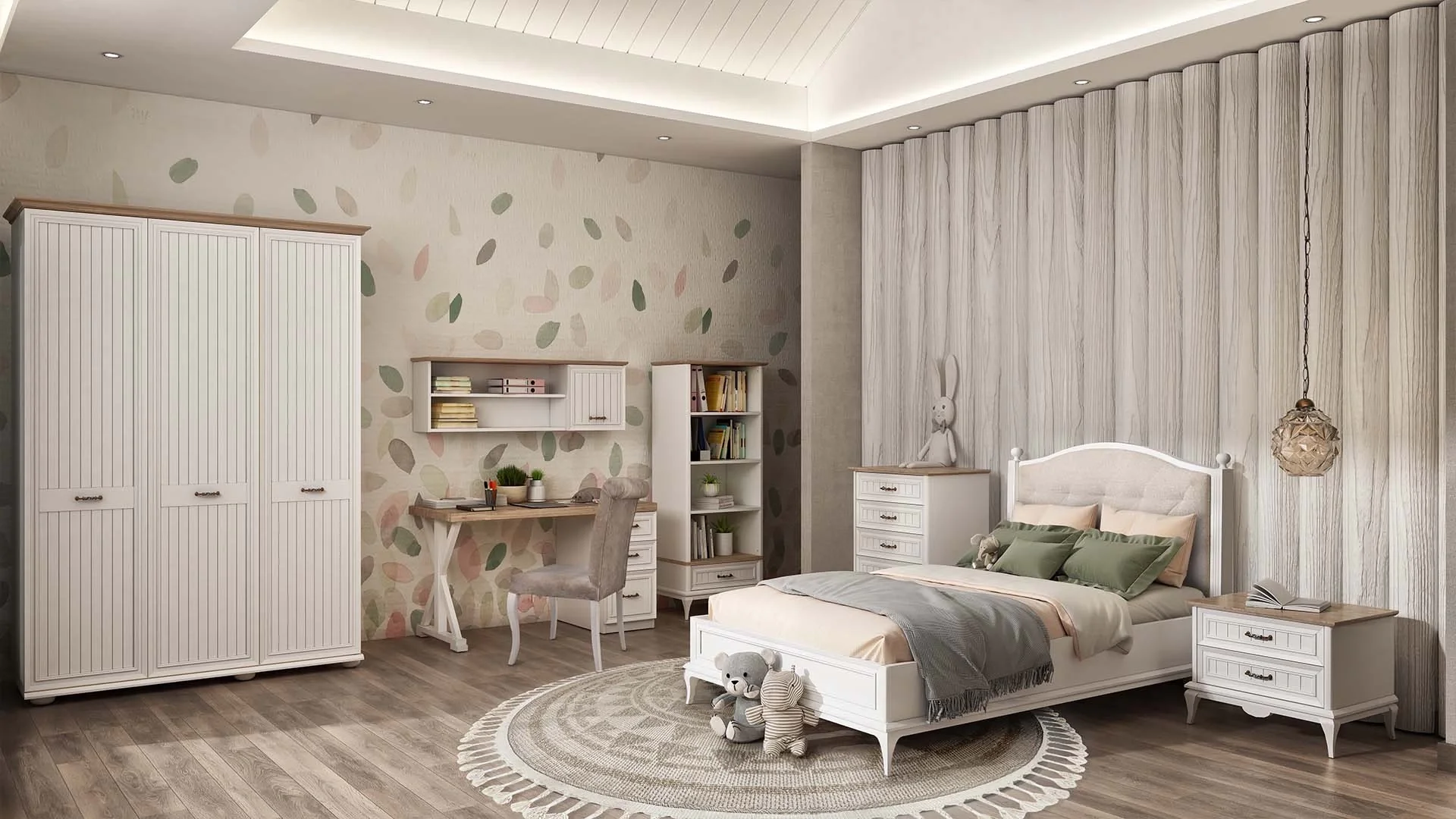
Colors are powerful tools that directly affect children's emotional development and mood. Therefore, the colors used in children's room decoration should be chosen carefully. Below you can see the psychological effects of commonly used colors individually:
- Blue: Known for its calming effect. Ideal for hyperactive children, it facilitates falling asleep.
- Green: Relaxing because it is associated with nature. Supports the ability to focus and can be preferred in study corners.
- Yellow: Provides joy and energy. However, it can create discomfort if used intensely; it's more suitable for use in accessories.
- Pink: Especially in younger age groups, it evokes feelings of security and affection. However, if used too dominantly, it can be overwhelming.
- Purple: Stimulates imagination. Pastel tones are especially suitable for reading corners.
- Neutral tones like gray and beige: Can be used as the base and easily harmonize with other colors to create balance.
The dosage of colors, their areas of use, and combinations are also important. Instead of overwhelming the whole room with a single color, using different colors in distinct areas to create balance is healthier.
How to Plan a Functional and Organized Children's Room?
Functionality is crucial in children's rooms to maintain order and increase space efficiency. Especially in small-square-meter rooms, proper planning can create comfortable play, sleep, and storage areas.
The furniture used in the children's room should be selected according to the child's age and needs. Modular furniture offers long-term solutions as it can easily adapt to changing needs over time. High platform bed models allow for the creation of a workspace or play area underneath, saving space.
Storage areas directly impact the room's order. Open shelf systems, toy boxes,
bookshelves, and cabinets with drawers help maintain a tidy environment. Placing items within the child's reach to promote responsibility is beneficial.
Leaving the transition areas in the room clear provides both safety and free movement space. Rooms cluttered with too many items can be both boring and distracting for children.
During the planning phase, finding solutions that balance both the child's and the parents' needs is the best approach. This way, the child becomes part of an ordered environment while parents can manage their daily routines more easily.
How Should Decoration Change According to Children's Age and Development Periods?
Since each age period has different needs and expectations, children's room decoration should be shaped accordingly. Instead of a fixed decoration, a flexible, transformable approach yields healthier results.
For children aged 0–3, safety and easy access should be prioritized. Soft surfaces, protective edges against falling, and simple furniture should be preferred. In this period, contrasting colors and educational visuals can be used on the walls.
From ages 3–6, a play-focused structure becomes important. Easy access to toys, large play areas, wall panels, and creative spaces (e.g., a chalkboard-painted surface) support this age group.
In the 6–12 age group, individuality begins to emerge. A desk, bookshelf, and personal storage areas that the child can organize themselves become prominent. Color choices can be shaped according to the child's character, and part of the room can be dedicated to hobbies.
In the adolescent period (12+), simplification and privacy come to the forefront. More adult-style furniture, neutral colors, and areas for individual use (study corner, special lighting, reading area) gain importance.
Gradually renewing the decoration according to changing needs with age strengthens the child's bond with the room.
How to Balance Study and Play Areas?
There should be spaces for both learning and play in the child's room. However, it's important to separate these areas in a balanced manner. Below are tips for establishing this balance:
- Physically divide the areas: Even if the room is small, you can visually separate play and study areas with a rug or a bookshelf.
- Avoid distractions in the study area: Creating a simple desk area away from toys and colorful objects makes it easier to concentrate.
- Provide freedom in the play area: Colorful boxes, low shelves, and soft surfaces allow comfortable movement while playing.
- Make lighting distinctions: Use a strong and directional desk lamp for the study area; soft and scattered light is sufficient for the play area.
- Share storage spaces: Use common shelving systems for toys and stationery products to help the area stay orderly.
With this balance, a child can both have fun and learn, spending productive time in their room. At the same time, it develops responsibility and an organization habit.
What Are Common Decoration Mistakes in Children's Rooms?
Some unnoticed mistakes during decoration can negatively affect the functionality and safety of a children's room. Here's a look at common decoration mistakes:
- Focusing solely on visuals: When aesthetic choices take precedence over safety and ease of use, problems can arise.
- Using furniture not suitable for age: Products not appropriate for the child's height, age, and needs complicate daily life.
- Filling the room with too many items: Constraining the area limits the child's freedom of movement and stifles the room's energy.
- Insufficient lighting plan: Inadequate general and regional lighting is detrimental to eye health and concentration.
- Lack of storage space: Clutter is both aesthetically displeasing and negatively affects the habit of organization.
By avoiding these mistakes, it is possible to create a children's room that is both functional and aesthetically balanced. Remember, the best room is where the child feels free and supported in their development.























 Contact us
 +90 850 800 34 87